AI automation is most useful when it improves a defined business process, not when it is added because a tool is fashionable or a competitor announced an “AI strategy.” A good system can summarize information, classify requests, prepare drafts, route work, detect patterns, and reduce repetitive coordination. It cannot own the purpose of the business, understand every unstated context, or accept accountability for a harmful decision.
That boundary is productive. Teams do not need to choose between manual work and unattended automation. They can design workflows where machines handle repeatable computation and preparation while people provide goals, judgment, empathy, approval, and exception handling. The result should be a better operating process, not merely more generated output.
The right role for AI automation
An AI-assisted workflow uses a model or AI service for one or more bounded tasks inside a process. An automated workflow also connects triggers, business rules, systems, and actions so work can move with less manual coordination. These are not the same thing.
For example, a language model might summarize a sales call. Automation determines when the transcript is available, which customer record it belongs to, what format the summary must follow, who reviews it, where the approved notes are stored, and what happens when the transcript is incomplete. The model is one component; the workflow creates operational value.
Human strategy remains responsible for:
- defining the business problem and acceptable outcome;
- deciding which data and constraints matter;
- setting risk tolerance and approval boundaries;
- understanding customers, context, and trade-offs;
- choosing when not to automate;
- monitoring effects and changing the process;
- accepting accountability for decisions and communications.
A useful principle is automate preparation before accountability. Let the system gather, transform, summarize, or propose. Keep a person in control where the business makes a promise, spends meaningful money, affects someone’s rights, publishes a claim, or manages a sensitive relationship.
Suitable and unsuitable automation use cases
Evaluate a task across frequency, structure, verifiability, consequence, data sensitivity, and reversibility.
Strong candidates
- repetitive classification using a stable and documented category set;
- extraction of known fields from consistent documents, followed by validation;
- summaries that link back to source material;
- first drafts created from approved facts and templates;
- routing requests based on explicit rules and confidence thresholds;
- detecting missing information or unusual patterns for human review;
- compiling recurring reports from governed data sources;
- suggesting next actions without executing them automatically;
- internal search across approved, current documentation;
- reminders and workflow coordination with clear fallback behavior.
These tasks are bounded. A reviewer can compare the output with a source or rule. Failure can be detected and corrected without hiding responsibility.
Weak or high-risk candidates
- final decisions about hiring, credit, healthcare, legal rights, safety, or other high-impact matters without qualified oversight;
- sending sensitive or emotionally complex customer responses without review;
- publishing factual claims when no verification process exists;
- autonomous pricing, discount, contract, or refund commitments outside approved rules;
- strategic decisions where goals, constraints, and evidence are contested;
- processing confidential information without a lawful purpose and suitable controls;
- workflows where nobody can explain, appeal, stop, or recover from a wrong action;
- tasks automated only because they are disliked, even though exceptions dominate the work.
“Human in the loop” is not enough if the reviewer cannot realistically assess the output. A person who must approve hundreds of items quickly may become a ceremonial checkbox. Design workload, evidence, escalation, and authority so oversight is meaningful.
A simple suitability scorecard
Use this table to test a task before you build anything. The lower-risk column points to a good first candidate. The higher-risk column is a sign to slow down and add controls.
| Question | Lower-risk signal | Higher-risk signal |
|---|---|---|
| Is the task defined? | Inputs, output, and acceptance criteria are explicit | The goal depends on unstated strategy or context |
| Can output be checked? | Source or rule allows practical verification | Correctness is subjective or discovered much later |
| What happens if it is wrong? | Reversible internal inconvenience | Financial, legal, safety, privacy, or reputational harm |
| Does it use sensitive data? | Minimal, governed, necessary data | Broad personal or confidential data without controls |
| Are exceptions manageable? | Clear route to a trained owner | Exceptions are frequent, ambiguous, or ignored |
| Is there a fallback? | Manual process and stop control exist | System failure blocks service or creates irreversible action |
Practical examples across the business
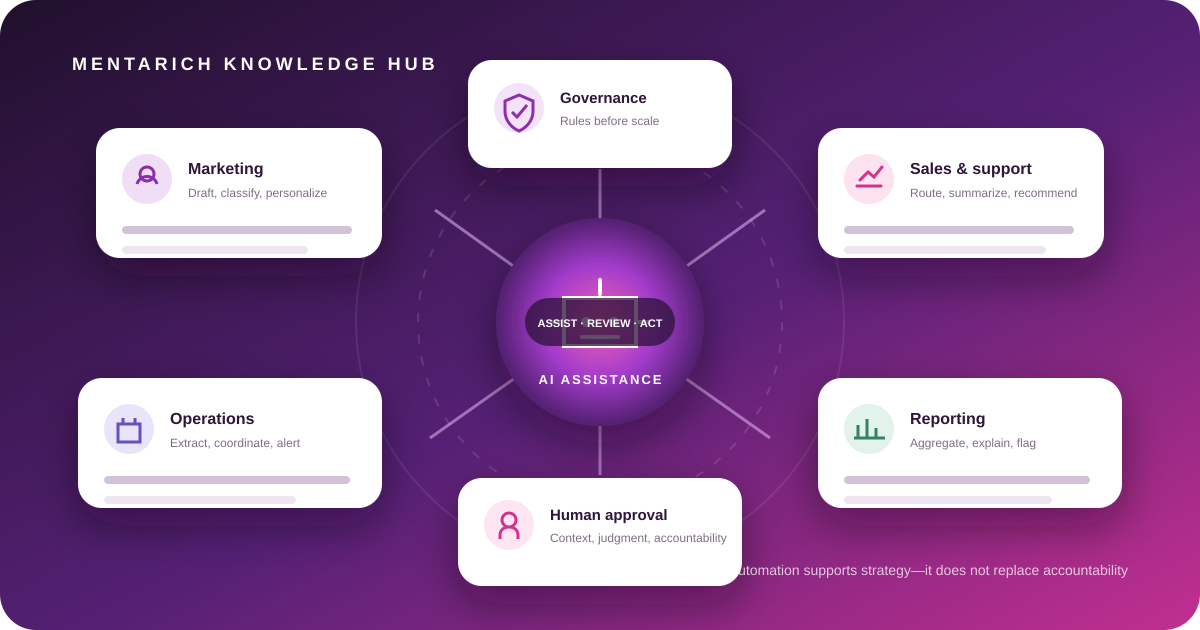
Marketing
AI can cluster research notes, draft content briefs, summarize campaign feedback, propose subject-line variants, identify repeated customer questions, or reformat approved material for different channels. A marketer should still define positioning, audience, evidence, brand voice, and publication standards.
A safe content workflow might retrieve approved product facts, generate an outline, flag unsupported claims, and send the draft to an editor. The editor verifies sources, adds experience and judgment, checks originality, and decides whether to publish. That is very different from automatically producing hundreds of pages to chase keywords.
For discovery work, the SEO vs AEO vs GEO guide explains why technically available content still needs clarity, evidence, and genuine source value.
Sales
AI can summarize calls, extract action items, prepare account research, suggest follow-up drafts, or identify records missing required fields. It should not invent customer needs, change a contract, promise delivery, or send a sensitive negotiation response without an authorized person.
Design approval according to consequence. A low-risk reminder may be automatic. A follow-up draft should be reviewed. Pricing and contractual commitments should follow existing authorization rules regardless of whether AI prepared the recommendation.
Customer support
Useful applications include intent classification, knowledge retrieval, conversation summaries, suggested replies, translation assistance, and escalation detection. Customers should have a clear path to a person when the issue is sensitive, complex, disputed, or outside known documentation.
Ground responses in current support content and show the agent the source. Track whether suggested answers are accepted, edited, rejected, or associated with reopenings. A faster first reply is not an improvement if resolution quality declines.
Operations
AI can extract fields from forms, compare submissions with requirements, route approvals, reconcile naming differences, generate handover notes, and flag anomalies. Deterministic rules should handle conditions that must always behave the same. Use probabilistic models for tasks where uncertainty is expected and managed.
Do not hide a fragile process behind automation. Standardize owners, inputs, states, and exception routes first. Otherwise, the system accelerates inconsistency.
Reporting and analysis
AI can assemble narrative summaries from governed metrics, explain a dashboard in plain language, compare periods, and highlight items for investigation. Keep calculations in reliable analytics or database systems; use the model to communicate results rather than invent numbers.
Every generated report should identify its data sources, period, definitions, and limitations. A reviewer should be able to trace a claim back to the underlying metric.
Where human approval belongs
Set approval points according to consequence, not convenience.
| Workflow moment | AI contribution | Human responsibility |
|---|---|---|
| Goal setting | Organize options or prior evidence | Define purpose, constraints, and acceptable trade-offs |
| Input preparation | Extract, classify, or summarize | Confirm data is appropriate, complete, and permitted |
| Drafting | Produce a structured first version | Verify facts, tone, context, and originality |
| Recommendation | Rank or explain options | Challenge assumptions and make accountable decisions |
| External communication | Prepare a response | Approve commitments, claims, and sensitive messages |
| Execution | Trigger low-risk reversible steps | Authorize high-impact or irreversible actions |
| Monitoring | Flag anomalies or drift | Investigate, correct, pause, and communicate incidents |
Use at least four control types:
- Confidence and rule thresholds: low-confidence or policy-sensitive items route to a person.
- Source visibility: reviewers see the evidence used, not only the generated conclusion.
- Stop and rollback controls: authorized owners can pause execution and restore a safe process.
- Audit records: store relevant input, output, model or configuration version, approval, and final action according to retention policy.
Approval is also a product-design problem. Show differences, highlighted uncertainty, missing data, and policy conflicts so the reviewer spends attention where it matters.
Risk and governance without unnecessary bureaucracy
Governance should scale with risk
A small internal summarization pilot does not need the same process as a system affecting customer eligibility. Both still need an owner, purpose, data boundary, evaluation, and fallback.
The US National Institute of Standards and Technology describes its AI Risk Management Framework as voluntary guidance for incorporating trustworthiness considerations into the design, development, use, and evaluation of AI systems. Its four functions, Govern, Map, Measure, and Manage, provide a practical structure:
Govern
Define roles, policies, decision rights, documentation, escalation, and risk tolerance. Maintain an inventory of active AI use cases so experimentation does not become invisible production infrastructure.
Map
Document the intended purpose, users, context, data, dependencies, foreseeable benefits, harms, and affected people. Include what the system must not do. Map upstream vendors and downstream actions, because risk can enter through either side.
Measure
Evaluate the workflow against realistic cases, including edge cases and adversarial or ambiguous inputs. Measure quality by group or scenario where relevant. Include human-review performance, not just model scores.
Manage
Prioritize risks, apply controls, monitor production behavior, respond to incidents, and retire systems that no longer meet the need. Reassess when the model, prompt, data, vendor, business process, or regulation changes.
NIST’s Generative AI Profile extends the framework for risks specific to or intensified by generative systems. It reinforces that risk management applies across the lifecycle, not only during a pre-launch review.
A lightweight governance record can include:
- use-case name, owner, and business purpose;
- approved and prohibited uses;
- data classes and vendors involved;
- known limitations and risk rating;
- evaluation set and acceptance criteria;
- human approval and escalation roles;
- monitoring signals and review schedule;
- incident, pause, fallback, and retirement procedures.
Data privacy, hallucination, and quality control
Data privacy
Do not send data to a model simply because an API makes it easy. Apply data minimization: use only what the task requires. Separate personal, confidential, regulated, and public information. Review vendor terms for retention, training, subprocessors, access, location, deletion, and incident response.
Ask:
- What is the lawful and documented purpose for this processing?
- Can fields be removed, masked, tokenized, or processed locally?
- Who can submit data and view outputs?
- How long are prompts, files, logs, and derived records retained?
- Can a customer or employee use a non-AI route when appropriate?
- What happens if the vendor changes terms or the integration fails?
Privacy obligations vary by jurisdiction and context. Treat this as a design checklist, not legal advice, and involve qualified counsel or privacy professionals for applicable requirements.
Hallucination and unsupported output
Generative models can produce plausible statements that are false, outdated, or unsupported. Do not attempt to solve this with a disclaimer alone.
Use layered controls:
- retrieve from a limited set of approved, current sources;
- require citations or source identifiers in the output;
- verify that cited passages actually support the claim;
- use deterministic validation for dates, totals, IDs, and required fields;
- prohibit unsupported claims and sensitive recommendations in the instruction and workflow;
- send uncertainty, missing evidence, and conflicts to a reviewer;
- test examples designed to tempt the model to guess;
- record corrections and add them to future evaluation sets.
Bias, tone, and customer impact
Review whether classifications or recommendations perform differently across relevant user groups or languages. Test respectful tone, accessibility, and escalation. A support assistant that is factually accurate but dismissive can still damage the customer experience.
Security and prompt injection
Treat retrieved web pages, documents, emails, and user input as untrusted data. They may contain text intended to manipulate the model or workflow. Limit tool permissions, separate instructions from retrieved content, allowlist actions, validate outputs, and require approval before sensitive execution. Never give a general assistant credentials or access beyond the task it performs.
Claims about the automation itself
Describe capabilities and limitations accurately. The US Federal Trade Commission’s business guidance, including its warning to keep AI claims in check, emphasizes that unsupported or exaggerated claims can be deceptive. Avoid promising that a model is unbiased, perfectly accurate, or equivalent to a professional when evidence does not support that statement.
An AI automation maturity model
Level 0: Unmanaged experimentation
Individuals use tools without shared data rules, ownership, evaluation, or visibility. The immediate need is not more automation; it is an inventory, basic policy, and safe experimentation boundary.
Level 1: Assisted tasks
AI helps with isolated drafts, summaries, or classifications. People initiate and review every use. Establish approved tools, prohibited data, source checks, and a way to report problems.
Level 2: Governed workflows
A repeatable process connects triggers, approved data, a model task, validation, human approval, and a destination system. Owners track quality, edits, exceptions, time, and incidents. This is the appropriate target for many first production pilots.
Level 3: Integrated operations
Several governed workflows share identity, permissions, logging, evaluation, and monitoring. Teams manage model or vendor changes, reusable controls, cost, and incident response. Automation supports cross-functional operations without hiding ownership.
Level 4: Adaptive portfolio
The organization reviews AI systems as a portfolio. It compares benefits with risk, retires weak use cases, updates controls from incidents, and allocates oversight according to consequence. Greater autonomy is granted only where evidence and fallback mechanisms justify it.
Do not pursue the highest level as a status symbol. A small business may gain more from two reliable Level 2 workflows than from an ambitious autonomous system nobody can govern.
AI automation pilot checklist
Define the problem
- Name the user, task, current pain, and desired outcome.
- Document the existing process, volume, cycle time, quality, cost, and exceptions.
- Confirm that process simplification or deterministic automation is not the better answer.
- Select a bounded use case with reversible consequences.
Set controls
- Assign a business owner and technical owner.
- Classify data and approve vendors, access, retention, and deletion.
- Define prohibited actions and content.
- Specify human approval and escalation points.
- Provide source evidence to reviewers.
- Create manual fallback, stop, and rollback procedures.
Evaluate before rollout
- Build a representative test set including difficult and failure cases.
- Define quality and risk acceptance criteria before seeing results.
- Test hallucination, missing data, unsafe instructions, and ambiguous inputs.
- Measure reviewer time and downstream rework.
- Confirm logs contain enough context for investigation without retaining unnecessary data.
Roll out carefully
- Begin with internal users or a limited segment.
- Train reviewers on limitations and escalation.
- Monitor quality, adoption, exceptions, and incidents.
- Compare against the baseline and a non-AI alternative.
- Decide to expand, revise, pause, or stop based on evidence.
Mentarich’s AI Solutions and Automation service focuses on this workflow-level implementation rather than installing an ungoverned chatbot and calling it transformation.
Measurement criteria that matter
Measure whether the complete process improved.
Efficiency
- cycle time from trigger to accepted completion;
- active human effort, including review and correction;
- backlog or response-time change;
- operating and vendor cost per completed unit.
Quality
- acceptance without edit, acceptance with edit, and rejection rates;
- factual or policy error rate on a representative sample;
- downstream rework, reopened cases, or corrections;
- consistency across languages, segments, and edge cases where relevant.
Risk and control
- sensitive-data violations or blocked submissions;
- low-confidence and escalation frequency;
- unauthorized actions prevented;
- incidents, near misses, and time to detection or recovery;
- completion of required human approvals.
Adoption and experience
- eligible users who use the workflow appropriately;
- reviewer trust calibrated to actual performance;
- employee effort and clarity, not only management estimates;
- customer satisfaction, resolution, conversion, or retention where the workflow can reasonably influence it.
Business outcome
Tie the pilot to its original objective: better response quality, more consistent follow-up, shorter processing time, fewer missed requirements, or faster access to governed information. Do not substitute “tokens generated” or “tasks automated” for customer or operational value.
Human strategy is the control system
AI automation can help a business move faster when goals, data, rules, ownership, and review are explicit. It can also magnify weak processes and unsupported assumptions when those foundations are missing. The practical advantage is not removing people from every step; it is using automation to give people better information, less repetitive work, and more time for decisions that need context.
Start with one bounded workflow. Measure the current process. Design approvals around consequence. Protect data. Test failure, not only the happy path. Expand only when quality and control remain visible. If you need help turning a use case into a responsible pilot, contact Mentarich to define the workflow, controls, and measurement plan before implementation.