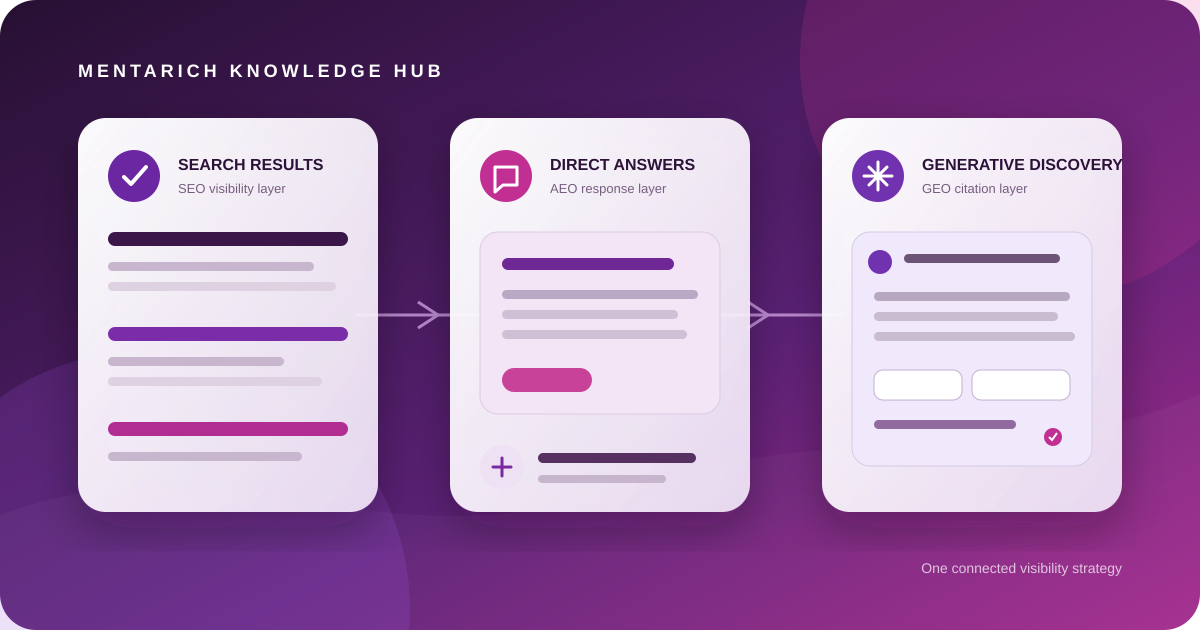
People find businesses in very different ways now. One customer scrolls through regular search results. Another reads a short featured answer without clicking. Someone else asks a voice assistant, or compares options inside an AI-generated response. These different experiences gave us three overlapping disciplines: search engine optimization (SEO), answer engine optimization (AEO), and generative engine optimization (GEO).
These names only help when they make a decision clearer. Treated as competing trends, or sold as shortcuts, they just add confusion. This guide explains what each discipline actually does, where the boundaries blur, and how to build a visibility plan around the way your real customers search.
SEO, AEO, and GEO definitions in plain English
What is SEO?
Search engine optimization (SEO) is the practice of improving a website so search systems can access, understand, evaluate, and show its pages for relevant queries. The work includes technical accessibility, information architecture, on-page content, internal linking, digital authority, and the experience people get after they click.
Traditional SEO often targets search result pages on Google or Bing, but the discipline is broader than “ranking blue links.” Image results, local results, videos, shopping experiences, and other search features also depend on discoverable assets and clear page meaning.
Google’s Search Essentials organizes the baseline around technical requirements, spam policies, and key practices. That is an important reminder: no copywriting formula compensates for blocked crawling, accidental noindex directives, broken pages, or content that does not help the intended reader.
SEO is usually the strongest first priority when a business needs:
- qualified visits to service, product, location, or educational pages;
- durable visibility across a portfolio of topics;
- discoverability for branded and non-branded demand;
- control over the destination where a visitor evaluates and converts;
- measurable journeys from query to visit, lead, signup, or sale.
What is AEO?
Answer engine optimization (AEO) improves how clearly a source can answer a specific question in an answer-oriented experience. Those experiences include featured snippets, related-question modules, voice responses, knowledge panels, internal site assistants, and other interfaces that present an answer before or instead of a standard list of links.
AEO is not “SEO with shorter paragraphs,” and it is not a quick fix. A useful answer needs the correct scope, enough context to avoid being misleading, and a source the system can interpret. Concise definitions, descriptive headings, lists, comparison tables, entity clarity, and valid structured data can help, but only when they reflect the visible page.
Google explains that its systems decide whether a page is appropriate for a featured snippet; publishers cannot mark a page as a guaranteed featured snippet. That distinction matters. AEO should improve information quality and extractability, not promise ownership of an answer box.
AEO deserves more attention when customers repeatedly ask questions such as:
- “What does this service include?”
- “How is option A different from option B?”
- “What documents do I need?”
- “How long does this process usually take?”
- “Can this product integrate with my current system?”
What is GEO?
Generative engine optimization (GEO) is the practice of improving the likelihood that a brand’s accurate, useful information can be discovered, interpreted, and referenced in generative search or answer experiences. These systems may synthesize information across multiple sources and present a composed response with supporting links or citations.
GEO is not simply “the future,” because generative discovery already exists alongside other channels, and adoption varies by audience and task. It is also not a guaranteed method for forcing a model to recommend a brand. Platforms use different retrieval, ranking, model, and citation processes that change over time.
A responsible GEO program focuses on elements a business can control:
- accessible pages with important information available as text;
- clear explanations of products, services, people, and organizations;
- original expertise, examples, frameworks, or first-party information;
- claims supported by transparent evidence;
- consistent entity details across owned and credible external sources;
- monitoring that distinguishes a mention, a citation, a referral, and a business outcome.
Google’s guidance for AI features and websites says pages must be indexed and eligible for a normal Search snippet to be eligible as supporting links in AI Overviews or AI Mode; it lists no additional technical requirement. This is one practical reason GEO should build on SEO rather than bypass it.
SEO vs AEO vs GEO comparison
| Dimension | SEO | AEO | GEO |
|---|---|---|---|
| Primary goal | Earn relevant visibility and visits from search experiences | Make an accurate answer easy to identify and present | Make useful brand information discoverable and referenceable in generative responses |
| Typical interfaces | Organic results, local results, images, videos, rich results | Featured snippets, related questions, voice or direct-answer interfaces | AI Overviews, AI search modes, conversational research and answer tools |
| Core unit | A page or asset matched to search intent | A clear answer within a trustworthy page or data source | A well-supported passage, entity, claim, or source that can contribute to synthesis |
| Main foundation | Crawlability, indexability, relevance, quality, authority, user experience | SEO foundation plus direct structure, question coverage, entity clarity, accurate markup | SEO foundation plus distinctive information, corroboration, consistency, and source-level trust |
| Common success signals | Qualified clicks, organic conversions, non-brand visibility, indexed coverage | Answer-feature presence, qualified assisted visits, resolved customer questions | Cited or linked mentions, generative referrals, brand inclusion for relevant prompts, assisted outcomes |
| Main risk | Chasing rankings without business relevance | Reducing nuanced questions to incomplete sound bites | Treating volatile model outputs as guaranteed placement or publishing unsupported “AI-friendly” claims |
The table shows emphasis, not hard boundaries. A comparison page can rank in traditional search, provide an answer-friendly table, and become a source in a generative response. Strong assets often serve all three contexts because they are technically available, editorially clear, and substantively useful.
Real-world discovery examples
Consider a software company selling inventory management tools.
Traditional search result
A buyer searches “inventory management software for multiple warehouses.” The search page offers category pages, product pages, reviews, and guides. SEO helps the company’s relevant page become eligible and competitive. The page still needs to convince the buyer after the click with clear capabilities, integrations, proof, and a sensible next step.
Direct answer experience
The same buyer asks, “What is multi-warehouse inventory management?” An answer engine may highlight a concise definition from a detailed guide. AEO work would make that definition explicit, place it under a descriptive heading, distinguish it from adjacent concepts, and support it with the rest of the page.
Generative research experience
The buyer asks an AI system to explain selection criteria for a multi-warehouse tool. The generated response may synthesize criteria such as stock synchronization, transfer workflows, reporting, permissions, and integrations. GEO work would ensure the company has a useful, evidence-led resource addressing those criteria without turning it into disguised sales copy.
The commercial opportunity differs in each case. The first may create a direct visit. The second may build recognition without a click. The third may influence a shortlist early in the buying journey. A complete measurement plan acknowledges those differences instead of evaluating every channel solely by last-click traffic.
Which strategy does your business need?
Use four questions to decide sequence and investment.
1. Is the website technically discoverable and commercially useful?
If core pages are blocked, duplicated, slow, unclear, or unable to convert, prioritize SEO and product fundamentals. Adding FAQ markup or publishing “GEO content” cannot repair an inaccessible foundation. Resolve crawl paths, canonicalization, indexation, navigation, page intent, and conversion measurement first.
2. How does the audience research the decision?
Interview sales, support, and customers. Review internal site search, Search Console queries, sales-call notes, and community discussions. If people ask repeated factual questions, AEO-oriented structures can improve both discovery and on-site comprehension. If they use AI tools to compare complex options, add generative monitoring and source development to the plan.
3. What information can the business contribute credibly?
Generic summaries are easy to reproduce. A business creates stronger source value through genuine expertise: a transparent process, a useful decision model, technical documentation, original product information, practitioner explanations, or responsibly collected first-party research. Do not manufacture statistics or case studies to appear authoritative.
4. What outcome matters?
A local emergency service may prioritize calls and location visibility. A B2B platform may value qualified demos and shortlist inclusion. A publisher may care about readership and subscriptions. Pick tactics and KPIs after defining the outcome, not before.
A practical prioritization model looks like this:
- SEO first: the site has technical or content gaps, organic demand exists, and visits can create value.
- SEO plus AEO: customer questions are central to evaluation, support, or local/service discovery.
- SEO plus AEO plus GEO: buyers use generative systems for research, and the business has expertise worth citing.
- Foundation before channels: the offering, positioning, analytics, or website experience is not clear enough to support any visibility program.
For a structured assessment, Mentarich’s SEO, AEO, and GEO service connects the three disciplines instead of selling them as isolated packages.
How SEO, AEO, and GEO work together
The most efficient model is a shared content and technical system.
First, research the audience’s jobs, questions, comparison criteria, and objections. Map them to pages with one clear primary purpose. Then make those pages easy to crawl and navigate. Within the page, answer the central question early, but preserve the context needed for a responsible decision. Add structured data only when it accurately describes what readers can see.
Google describes structured data as a standardized way to provide explicit clues about page meaning in its structured data introduction. It can support eligibility for certain rich experiences, but it does not replace visible information, quality, or relevance. There is also no special universal “GEO schema” that guarantees generative citations.
Finally, strengthen the source beyond the page. Keep organization and author details consistent. Earn relevant references through useful work and legitimate relationships. Maintain documentation when products or policies change. Search and answer visibility deteriorates when the source becomes stale, contradictory, or promotional at the expense of accuracy.
This integrated workflow also improves the human experience. Clear headings help scanners. Direct definitions reduce confusion. Comparison tables support evaluation. Citations let readers verify claims. Internal links guide the next question. Those benefits remain valuable even when an answer feature or generative platform changes.
Measurement and KPIs
Measure the system at three levels: availability, visibility, and business value.
SEO indicators
- important pages indexed and canonicalized correctly;
- crawl or rendering issues resolved;
- qualified impressions and clicks for relevant query groups;
- organic landing-page engagement and conversion quality;
- non-brand discovery without losing branded demand;
- contribution to leads, signups, sales, or other defined outcomes.
AEO indicators
- answer-oriented queries and pages covered with useful responses;
- presence in relevant featured or related-question experiences where observable;
- assisted visits from answer surfaces;
- reduced repetition in sales or support questions after content improvements;
- engagement with definitions, comparison tables, and FAQ sections.
GEO indicators
- brand or source inclusion across a documented set of relevant prompts;
- whether the mention is accurate, linked, cited, or unsupported;
- referrals from generative platforms where analytics can identify them;
- prompt themes that lead to qualified engagement;
- assisted conversions or sales feedback indicating generative research influenced the journey.
Generative outputs vary by platform, model, location, personalization, and time. Treat prompt monitoring as directional research, not an absolute rank tracker. Keep a repeatable prompt set, record the environment and date, and compare patterns rather than reacting to one answer.
A practical implementation roadmap
Phase 1: Establish the baseline
Confirm analytics, conversion events, Search Console access, crawling controls, XML sitemaps, canonical behavior, and indexation. Inventory the pages that support revenue, customer success, trust, and product understanding. Fix critical technical barriers before expanding content.
Phase 2: Map intent and questions
Group demand by task: learn, compare, evaluate, buy, troubleshoot, or verify. Combine keyword data with customer language from calls, emails, support tickets, and on-site search. Decide which page should satisfy each primary intent so multiple pages do not compete or repeat one another.
Phase 3: Improve core resources
For each priority page, add a clear purpose, direct opening, logical H2/H3 structure, examples, constraints, and a next step. Use tables when people genuinely compare dimensions. Cite external claims and identify the author or organization responsible for the information.
Phase 4: Add answer and entity clarity
Write concise definitions that remain accurate outside their surrounding paragraph. Make people, products, services, locations, and policies unambiguous. Add appropriate structured data that matches visible content. Connect related resources with descriptive internal links.
Phase 5: Build source value
Publish material competitors cannot create by paraphrasing a search page: tested workflows, product documentation, expert reasoning, transparent methodologies, or original research with disclosed methods. Update existing high-value resources rather than endlessly producing thin new pages.
Phase 6: Monitor and improve
Review search performance, answer surfaces, generative mentions, referral quality, and conversion outcomes together. Correct inaccurate information at the source. Refresh pages when products, evidence, or customer questions change. This is an operating discipline, not a one-time optimization sprint.
Myths and common mistakes
Myth: AEO is a quick way to skip competitive SEO
A clear answer still needs a page that can be discovered and trusted. Answer eligibility is not guaranteed, and an extracted sentence without context may not create business value. Build the source, not just the snippet.
Myth: GEO means repeating a brand name until AI systems notice it
Repetition is not evidence. Focus on accurate entity information, distinctive expertise, corroboration, and pages that deserve to be referenced. Artificial mentions or fabricated authority create reputational risk.
Mistake: publishing the same generic definition as everyone else
A definition may satisfy an introductory query, but it rarely differentiates the source. Add practical examples, decision criteria, limitations, and accountable authorship.
Mistake: marking up information that is not visible
Structured data should describe the page readers actually receive. Google’s general structured data guidelines emphasize relevance, completeness, and alignment with visible content. Do not add fake reviews, unsupported ratings, or FAQ data absent from the page.
Mistake: measuring channel artifacts instead of outcomes
A ranking, snippet, or mention can be useful, but none automatically equals a qualified customer. Connect visibility to the journey and evaluate lead or revenue quality where appropriate.
Mistake: separating search strategy from website quality
Discovery creates an opportunity; the website must complete the job. If the destination is confusing, inaccessible, or slow, more visibility can simply expose more people to a weak experience. The decision framework in Website Redesign vs Rebuild can help determine whether the constraint is visual or structural.
Actionable SEO, AEO, and GEO checklist
- Define the customer actions and business outcomes visibility should support.
- Confirm important pages are crawlable, indexable, canonical, and included in navigation.
- Map one primary intent to each core page.
- Collect real customer questions from search, sales, support, and product teams.
- Add direct definitions without removing necessary context or caveats.
- Use descriptive H2/H3 headings, lists, and tables where they improve decisions.
- Make organization, author, service, and product entities consistent.
- Add only structured data that accurately represents visible content.
- Publish evidence, examples, or frameworks that reflect genuine expertise.
- Link related articles and services with descriptive anchor text.
- Track search, answer, generative, and business indicators separately.
- Review accuracy and refresh priority resources on a defined schedule.
SEO, AEO, and GEO are not three disconnected campaigns. They are different views of the same responsibility: make valuable information available, understandable, credible, and useful at the point where a person is making a decision. If your team needs help deciding where to begin, contact Mentarich for a practical visibility roadmap rather than a channel-by-channel checklist.